Introduction to the BP Format
British Parliamentary (BP) is an impromptu format used at the World Universities Debating Championships and at many UK school-level debate competitions (including Oxford Schools and Cambridge Schools).
The topics for debate (known as ‘motions’) are released to teams 15 minutes in advance of the debate, and speakers must prepare their speeches on the spot, without reference to online sources. BP speeches are typically seven minutes long; however, most UK school-level BP competitions follow a modified format with five minute speeches.
Each debate involves four teams of two speakers each (two teams on each side of the motion). The two teams on the same side of the motion are independent of each other; each team is trying to win the debate and must position themselves against the other three teams in the round.
The teams supporting the motion are known as the Government teams, while the teams opposing the motion are the Opposition. The two teams speaking first on each side are known as the Opening teams, while the two teams speaking second on each side are known as the Closing teams. The sequence of the debate is illustrated below:
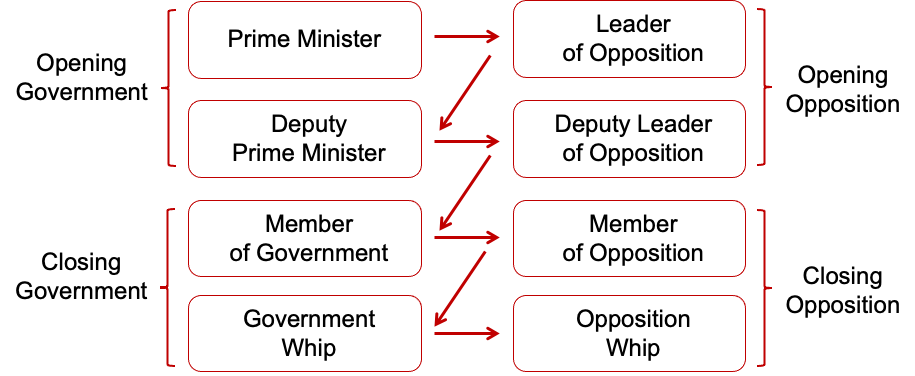
- The roles of the Prime Minister, the Leader of Opposition, and both Deputy speakers are similar to the roles of the First and Second speakers in the World Schools debating format.
- Closing Government and Closing Opposition must argue independently from their Opening teams, with the aim of showing that their team has made the most important contribution to the debate as a whole. As such, they should not rely wholesale on arguments and responses already presented by their Opening teams.
- The Members (also known as ‘Extension’ speeches) should further the debate by offering new arguments, new analysis for existing arguments, or new ways of conceptualising the round in support of their side.
- The Whips should not provide any new material; instead, they should respond to any outstanding material in the round, identify key disagreements (‘clashes’), and analyse why their partner’s contributions specifically were the most important in the round.
More information and resources can be found here:
- Debating at Oxford Schools: This is a guide to the BP format created by Oxford Union university debaters. It provides an overview of debating skills, speaker roles, motion types, and judging standards.
- The Cambridge Union Society Introductory Guide to Debating: This is a guide to the BP format created by Cambridge Union university debaters. It provides an overview of constructing strong arguments and rebuttals, the role of extension speeches and whip speeches, and speaking style.
- Oxford Schools Video Guides: This YouTube channel covers the basics of the BP format, as well as argument construction, rebuttal, speaking persuasively.
- ICYD Video Guides: This YouTube channel introduces the BP format along with workshops on preparing cases, closing half, and extension speeches.
 Debate England