Introduction to the World Schools Format
The World Schools format is used at the World Schools Debating Championships (WSDC). It involves two teams of three speakers each, also known as the Proposition team and the Opposition team, arguing for and against the motion respectively.
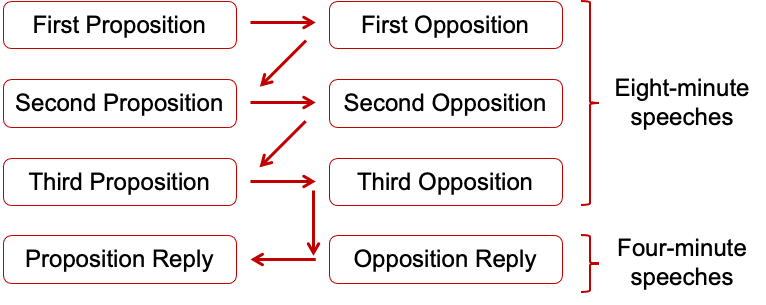
Each of the speakers will give an eight-minute speech. Between the first minute and the seventh minute of each speech, the opposing side is allowed to ask Points of Information (POIs) to the speaker, who may choose to accept or decline.
Following the completion of the six speeches, the first or second speaker of each team will present a four-minute summary speech for their side (‘Reply’ speech). No POIs are allowed during Reply speeches.
The sequence of the debate is illustrated below:
- The First Proposition speaker should define the motion, introduce a ‘policy’ if necessary (i.e., a plan to implement the motion), outline arguments that will be presented by the other Proposition speakers, and present arguments (also known as ‘substantives’ in favour of the motion.
- The First Opposition speaker has a similar role; in addition, they should also respond to the arguments presented by the First Proposition speaker (also known as ‘rebuttal’ or ‘refutation’).
- The Second Proposition speaker and the Second Opposition speaker should respond to the other side’s arguments, rebuild their previous speaker’s arguments if necessary, and present additional arguments for their side.
- The Third Proposition speaker and the Third Opposition speaker should respond to the other side’s arguments and advance their own case without introducing a new substantive. They are, however, allowed to introduce new responses, as well as new illustrations, reasons, and impacts for existing substantives.
- Reply speakers should not add new material; instead, they should comment on how the round unfolded by highlighting key features of the debate. Typically, this involves identifying the key disagreements in the debate (also known as ‘clashes’) and analysing how the interaction of arguments and responses within the debate results in their side winning each ‘clash’.
Competitions in the World Schools format typically have a mix of prepared and impromptu rounds. Preliminary rounds at WSDC, for instance, consist of four prepared debates (motions and sides released in advance), and four impromptu debates (one-hour preparation time from motion release; teams are not allowed to research the topic). WSDC elimination rounds are entirely impromptu.
More information and resources can be found here:
- The World Schools Debating Championship guide to debating: This is a comprehensive 20-page document detailing how teams should approach the motion, define key terms, and construct arguments for both sides.
- The World Schools Debating Championship training resources: This is a compilation of the training materials that have been released by WSDC Chief Adjudicators over the years. Materials linked on this page include speaker briefings, judge briefings, and a Coaches Support Pack.
- English Speaking Union guide to WSDC Format: This is a document that introduces the WSDC format and judging criteria.
- World Schools Debating League novice activity pack: This includes five activities meant to introduce new debaters to basic skills necessary for WSDC debating (e.g., following a debate, defining terms).
- Debating in the World Schools Style: A Guide: A book by Simon Quinn, published by the International Debate Education Association, with in-depth explanations of how to construct and structure cases, arguments, rebuttals, points of information, and more.
- Points of Information at WSDC: A summary of how Points of Information function in WSDC debate, along with a suggested activity.
Recorded rounds from past WSDCs:
 Debate England